
Neuroscience Assay Kits: Advanced Tools for Studying Neural Function, Signaling, and Cellular Physiology
Introduction: Understanding the Complexity of the Nervous System
The nervous system is one of the most complex biological networks, responsible for sensory perception, motor control, cognition, and adaptive behavior. Neuroscience research seeks to understand how neurons and glial cells communicate, how neural circuits are organized, and how molecular signaling pathways regulate brain function at the cellular and systems levels.
To address these questions, laboratories rely on Neuroscience Assay Kits—standardized experimental tools that enable quantitative measurement of neural activity, neurotransmitter dynamics, synaptic function, cellular metabolism, and neurobiological signaling pathways. These assays support reproducible and scalable neuroscience research across cell culture, tissue preparations, and experimental model systems.
The importance of neuroscience research is emphasized across major academic and government-supported initiatives, including programs funded by the National Institutes of Health (NIH) (https://www.nih.gov), the National Institute of Neurological Disorders and Stroke (NINDS) (https://www.ninds.nih.gov), and the National Science Foundation (NSF) (https://www.nsf.gov).

What Are Neuroscience Assay Kits?
Neuroscience Assay Kits are biochemical, cell-based, or imaging-compatible assays designed to measure functional and molecular parameters relevant to neural cells and circuits. These kits typically rely on colorimetric, fluorometric, luminescent, or electrochemical readouts compatible with standard laboratory instrumentation.
They are widely used in:
-
Cellular and molecular neuroscience
-
Neurobiology and neurophysiology research
-
Pharmacology and neurotoxicology
-
Academic teaching laboratories
-
Biotechnology and translational research
Foundational principles behind these assays are covered in university neuroscience curricula, including those hosted by Harvard Medical School (https://hms.harvard.edu), MIT OpenCourseWare (https://ocw.mit.edu), and University of California San Diego Neurosciences Program (https://neurosciences.ucsd.edu).
Core Biological Processes Studied Using Neuroscience Assay Kits
Neuronal Viability and Neuroprotection
Assessing neuronal survival and stress responses is central to many neuroscience studies. Neuroscience Assay Kits allow researchers to quantify:
-
Neuronal viability
-
Cytotoxicity and oxidative stress
-
Mitochondrial health in neurons
These measurements are foundational in experimental neurobiology, as outlined in research frameworks supported by NINDS (https://www.ninds.nih.gov) and described in teaching resources from University of Michigan Neuroscience Program (https://lsa.umich.edu/psych).
Neurotransmitter Release and Uptake
Neuronal communication relies on the controlled release and reuptake of neurotransmitters such as glutamate, GABA, dopamine, and serotonin. Neuroscience Assay Kits provide quantitative tools to measure:
-
Neurotransmitter synthesis
-
Vesicular release
-
Transporter-mediated uptake
Neurotransmission mechanisms are extensively documented in educational materials from NIH National Library of Medicine (https://www.ncbi.nlm.nih.gov), Johns Hopkins University School of Medicine (https://www.hopkinsmedicine.org), and University of California Los Angeles (UCLA) (https://www.ucla.edu).
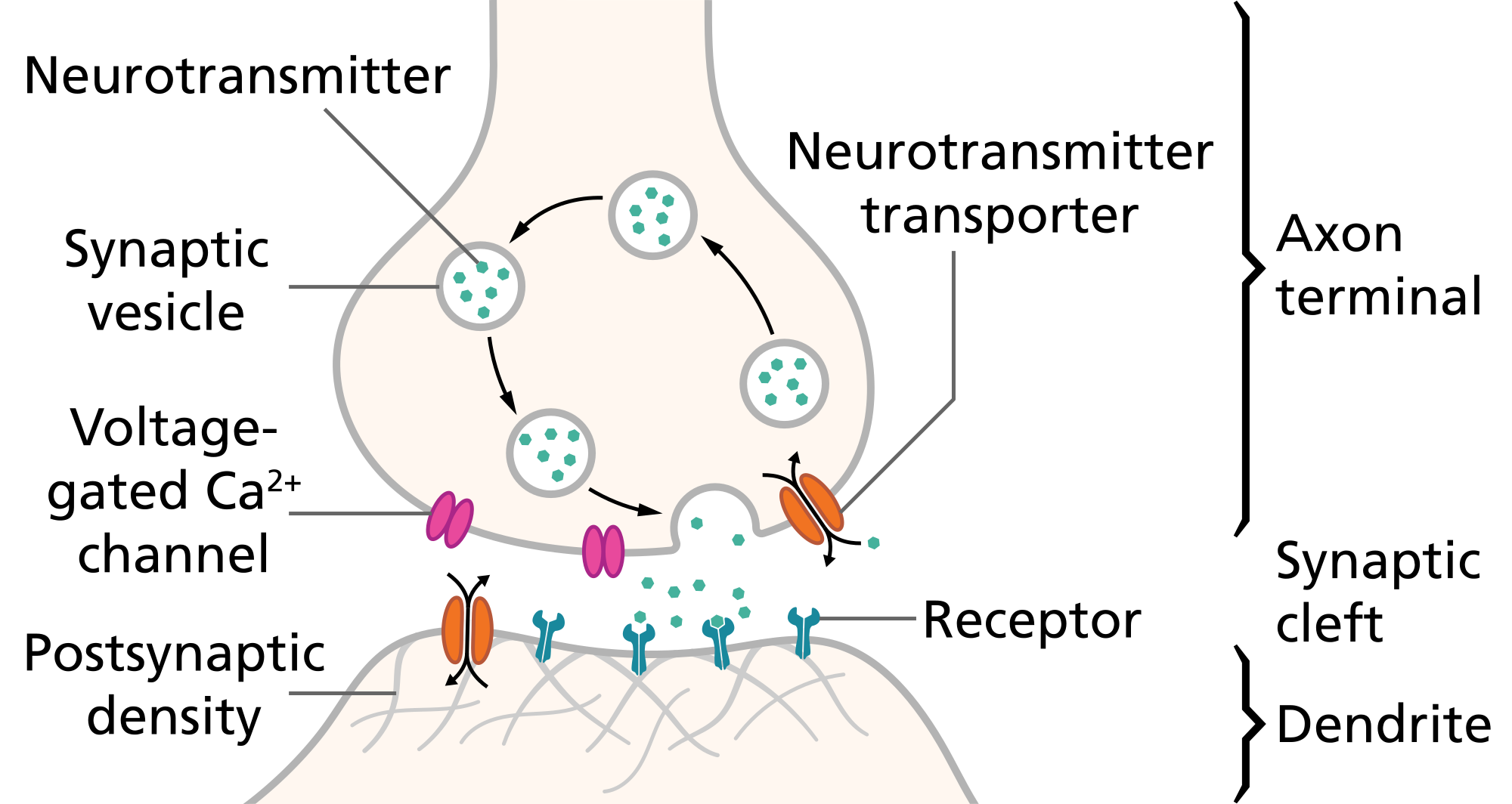
Synaptic Function and Plasticity
Synaptic plasticity underlies learning and memory and is a central focus of neuroscience research. Assays targeting synaptic markers allow investigation of:
-
Synapse formation and maintenance
-
Synaptic vesicle cycling
-
Postsynaptic receptor activity
Synaptic biology is emphasized in federally funded research programs coordinated by NIH BRAIN Initiative (https://braininitiative.nih.gov) and described in neuroscience education resources from Princeton University (https://www.princeton.edu).
Calcium Signaling in Neurons
Intracellular calcium dynamics play a critical role in neuronal excitability, neurotransmitter release, and gene expression. Neuroscience Assay Kits for calcium signaling enable:
-
Monitoring of neuronal activation
-
Analysis of calcium-dependent pathways
-
Functional assessment of ion channel activity
Calcium signaling principles are covered in laboratory protocols from Stanford University Neuroscience Institute (https://med.stanford.edu) and University of Washington Neurobiology Program (https://www.washington.edu).
Detection Technologies Used in Neuroscience Assay Kits
Fluorometric Assays
Fluorescence-based assays are widely used in neuroscience due to their sensitivity and compatibility with live-cell imaging. These assays enable real-time monitoring of neuronal activity and intracellular signaling.
Fluorometric detection methods are discussed in university microscopy courses from University of Wisconsin–Madison (https://neuroscience.wisc.edu) and University of Pennsylvania (https://www.med.upenn.edu).
Luminescent Assays
Luminescent assays, particularly ATP-based and reporter-gene assays, are used to assess neuronal metabolism and signaling with high sensitivity. These approaches are commonly employed in high-throughput neuroscience screening platforms supported by NIH NCATS (https://ncats.nih.gov).
Colorimetric Assays
Colorimetric assays remain valuable for endpoint analysis of enzymatic activity and oxidative stress markers, particularly in teaching and screening laboratories. Detection principles are outlined in educational biochemistry resources from Purdue University (https://www.purdue.edu) and University of Illinois Urbana–Champaign (https://mcb.illinois.edu).
Major Applications of Neuroscience Assay Kits
Basic Neuroscience Research
Neuroscience Assay Kits support fundamental investigations into neuronal signaling, development, and circuit function. These studies are central to academic neuroscience programs funded by NSF Biological Sciences Directorate (https://www.nsf.gov/bio) and NIH (https://www.nih.gov).
Neuropharmacology and Drug Screening
In pharmacological research, neuroscience assays are used to evaluate compound effects on neuronal viability, synaptic transmission, and signaling pathways. These approaches align with regulatory science frameworks from the U.S. Food and Drug Administration (FDA) (https://www.fda.gov) and are taught in pharmacology programs at University of California San Francisco (https://pharm.ucsf.edu).
Neurotoxicology and Environmental Research
Neuroscience Assay Kits are applied in studies examining the effects of environmental chemicals on neural cells. Government-supported neurotoxicology research is coordinated by the Environmental Protection Agency (EPA) (https://www.epa.gov) and described in educational materials from Agency for Toxic Substances and Disease Registry (ATSDR) (https://www.atsdr.cdc.gov).
Teaching and Training Laboratories
Neuroscience Assay Kits are widely used in undergraduate and graduate teaching laboratories, allowing students to explore neuronal biology through hands-on experiments. Teaching modules incorporating these assays are offered by:
-
University of Massachusetts Amherst (https://www.umass.edu)
-
University of Vermont (https://www.uvm.edu)
-
University of Georgia (https://www.uga.edu)

Advantages of Neuroscience Assay Kits
-
✔ Quantitative and reproducible data
-
✔ Compatible with standard plate readers and microscopes
-
✔ Suitable for live-cell and endpoint analysis
-
✔ Scalable from basic research to screening workflows
-
✔ Broad applicability across neuroscience disciplines
These advantages align with laboratory best practices promoted by the NIH Office of Research Infrastructure Programs (https://orip.nih.gov) and CDC laboratory training resources (https://www.cdc.gov/labs).
Best Practices for Experimental Design
To generate reliable neuroscience data:
-
Use biologically relevant neuronal models
-
Normalize data to cell number or protein content
-
Include appropriate positive and negative controls
-
Interpret results within physiological context
Experimental rigor principles are emphasized in federal research guidance from NIH Grants & Funding (https://grants.nih.gov) and academic methodology courses at University of California Los Angeles (https://www.ucla.edu).
Neuroscience Assay Kits in Integrative Brain Research
Modern neuroscience integrates molecular biology, imaging, electrophysiology, and computational analysis. Neuroscience Assay Kits provide functional measurements that complement transcriptomic and proteomic datasets, strengthening biological interpretation.
This integrative approach is promoted by large-scale research initiatives such as the NIH BRAIN Initiative (https://braininitiative.nih.gov) and interdisciplinary neuroscience programs at Columbia University (https://www.columbia.edu).
Conclusion
Neuroscience Assay Kits are essential tools for studying the molecular and cellular foundations of neural function. Their versatility, reproducibility, and compatibility with modern laboratory workflows make them indispensable in basic research, pharmacology, toxicology, and education.
By enabling precise measurement of neuronal activity, signaling pathways, and cellular health, these assays support deeper understanding of nervous system biology and contribute to the advancement of neuroscience research worldwide.
Neuroscience assay kits, neuronal activity assays, neurotransmitter analysis kits, synaptic function assays, calcium signaling assays, neurobiology research tools, neuroscience laboratory kits, neural signaling analysis