
Recast Protein Plus Gel, 12%, 10 Wells, HEPES-Tris: High-Resolution Protein Separation for Reliable SDS-PAGE Analysis (RUO)
High-quality protein separation is fundamental to modern biochemistry, molecular biology, and proteomics research. Whether confirming recombinant protein expression, assessing purity, or preparing samples for downstream immunodetection, researchers rely on consistent, reproducible SDS-PAGE performance.
The Recast Protein Plus Gel, 12%, 10 wells, HEPES-Tris is a precast polyacrylamide gel engineered to deliver sharp band resolution, uniform migration, and robust reproducibility for routine and advanced protein analysis workflows.
This article provides an in-depth, educational overview of Recast Protein Plus gels, focusing on scientific principles, laboratory applications, buffer chemistry, and data quality considerations, while remaining research-use-only (RUO) and free from clinical or diagnostic claims.
Why precast protein gels matter in modern laboratories
Traditional hand-cast polyacrylamide gels can introduce variability due to:
-
Inconsistent polymerization
-
Oxygen inhibition
-
Batch-to-batch differences in acrylamide concentration
-
Reproducibility challenges between operators
Precast gels address these limitations by offering controlled polymer composition, uniform thickness, and validated performance, enabling researchers to focus on experimental outcomes rather than gel preparation.
General educational background on gel electrophoresis principles can be found in these NIH and university resources:
-
NIH / NCBI Bookshelf – Gel electrophoresis overview:
https://www.ncbi.nlm.nih.gov/books/NBK26910/ -
University of Arizona – SDS-PAGE fundamentals (.edu):
https://www.biology.arizona.edu/biochemistry/problem_sets/gel_electrophoresis/gels.html
Understanding the Recast Protein Plus Gel format
12% polyacrylamide concentration: What does it resolve?
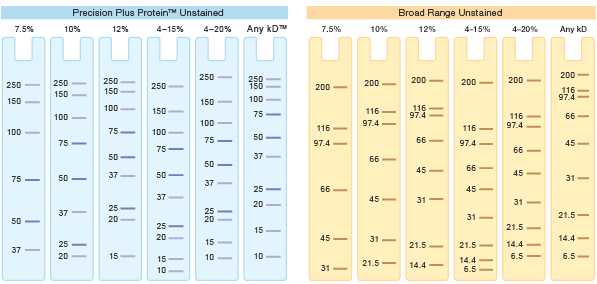
A 12% polyacrylamide gel is considered a mid-range resolving gel, well-suited for proteins approximately 15–100 kDa, making it highly versatile for:
-
Recombinant protein expression checks
-
Enzyme purity analysis
-
Cellular lysate profiling
-
Western blot sample preparation
Educational references discussing gel percentage and protein size separation include:
10-well format: Balanced throughput and resolution
The 10-well configuration allows researchers to:
-
Run multiple samples alongside molecular weight markers
-
Include positive and negative controls
-
Maintain sufficient lane width for downstream transfer and densitometry
This format is commonly used in routine analytical SDS-PAGE and Western blot workflows across academic and industrial laboratories.
HEPES-Tris buffer system: Why buffer chemistry matters
The HEPES-Tris buffer system used in Recast Protein Plus gels is designed to provide:
-
Stable pH during electrophoresis
-
Reduced band distortion
-
Consistent migration across lanes
Why HEPES?
HEPES is a zwitterionic buffer widely used in biological research due to its:
-
Minimal temperature-dependent pKa shifts
-
Low metal ion binding
-
Compatibility with protein structure and enzymatic activity
Authoritative buffer references:
-
NIH PubChem – HEPES buffer properties:
https://pubchem.ncbi.nlm.nih.gov/compound/HEPES -
Cold Spring Harbor Protocols – Buffer systems in electrophoresis (.edu/.gov indexed):
https://cshprotocols.cshlp.org/content/2006/1/pdb.rec10255
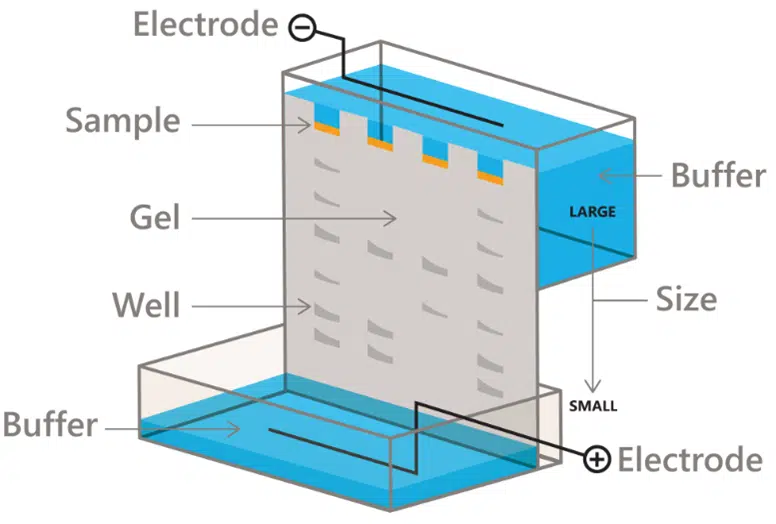
Principle of protein separation in SDS-PAGE (educational overview)
SDS-PAGE (sodium dodecyl sulfate–polyacrylamide gel electrophoresis) separates proteins primarily by molecular weight:
-
SDS binds to proteins, conferring a uniform negative charge
-
Reducing agents (e.g., DTT or β-mercaptoethanol) disrupt disulfide bonds
-
Proteins migrate through the polyacrylamide matrix under an electric field
-
Smaller proteins migrate faster than larger ones
Detailed NIH-supported explanations:
Core laboratory applications of Recast Protein Plus Gels
1. Recombinant protein expression analysis
Recast Protein Plus gels are commonly used to:
-
Confirm expression in bacterial, yeast, insect, or mammalian systems
-
Compare induced vs non-induced samples
-
Evaluate solubility fractions
Protein expression analysis concepts:
2. Protein purity and quality control
For purification workflows, SDS-PAGE provides:
-
Visual assessment of purity
-
Detection of degradation products
-
Comparison across purification steps
NIH educational resource on protein purification analysis:
3. Western blot preparation
After electrophoresis, proteins separated on Recast Protein Plus gels can be efficiently transferred to membranes for immunodetection.
Educational references:
-
NIH / NCBI – Western blot principles:
https://www.ncbi.nlm.nih.gov/pmc/articles/PMC4941626/ -
University of Leicester – Western blot guide (.edu):
https://www2.le.ac.uk/projects/vgec/schoolscolleges/teachingresources/biochemistry/western-blot
4. Comparative protein profiling
The consistent lane-to-lane performance of precast gels supports:
-
Comparative expression studies
-
Treatment-condition analysis
-
Knockdown or overexpression experiments
Sample compatibility and preparation considerations
Recast Protein Plus gels are compatible with:
-
Cell lysates
-
Purified proteins
-
Immunoprecipitated samples
-
Denatured protein preparations
General best practices (educational context):
-
Avoid overloading lanes
-
Use fresh reducing agents
-
Heat samples appropriately (typically 95 °C for denaturation)
NIH lab method guidance:
Data quality, reproducibility, and interpretation
Why reproducibility matters
Precast gels reduce:
-
Operator-dependent variability
-
Polymerization artifacts
-
Gel-to-gel inconsistencies
This is especially important for:
-
Quantitative densitometry
-
Comparative studies
-
Multi-lab collaborations
NIH reproducibility discussion:
Limitations to consider
While SDS-PAGE is powerful, it:
-
Does not measure protein activity
-
Does not distinguish isoforms of identical mass
-
Requires complementary techniques for confirmation
NIH review on proteomic limitations:
Choosing the right protein gel for your experiment
When selecting a precast gel, researchers typically consider:
-
Polyacrylamide percentage
-
Buffer system compatibility
-
Well number and sample volume
-
Downstream application (staining vs blotting)
-
Reproducibility and documentation
Educational comparison of gel systems:
Use these keywords naturally throughout your blog and product page:
-
Recast Protein Plus Gel
-
12% precast protein gel
-
HEPES-Tris SDS-PAGE gel
-
Protein electrophoresis gel
-
Precast polyacrylamide gel
-
SDS-PAGE protein separation
-
Western blot gel
Suggested meta description:
Recast Protein Plus Gel, 12%, 10 wells, HEPES-Tris—educational overview of precast SDS-PAGE gels for reproducible protein separation, purity analysis, and Western blot workflows (RUO).